

Blog
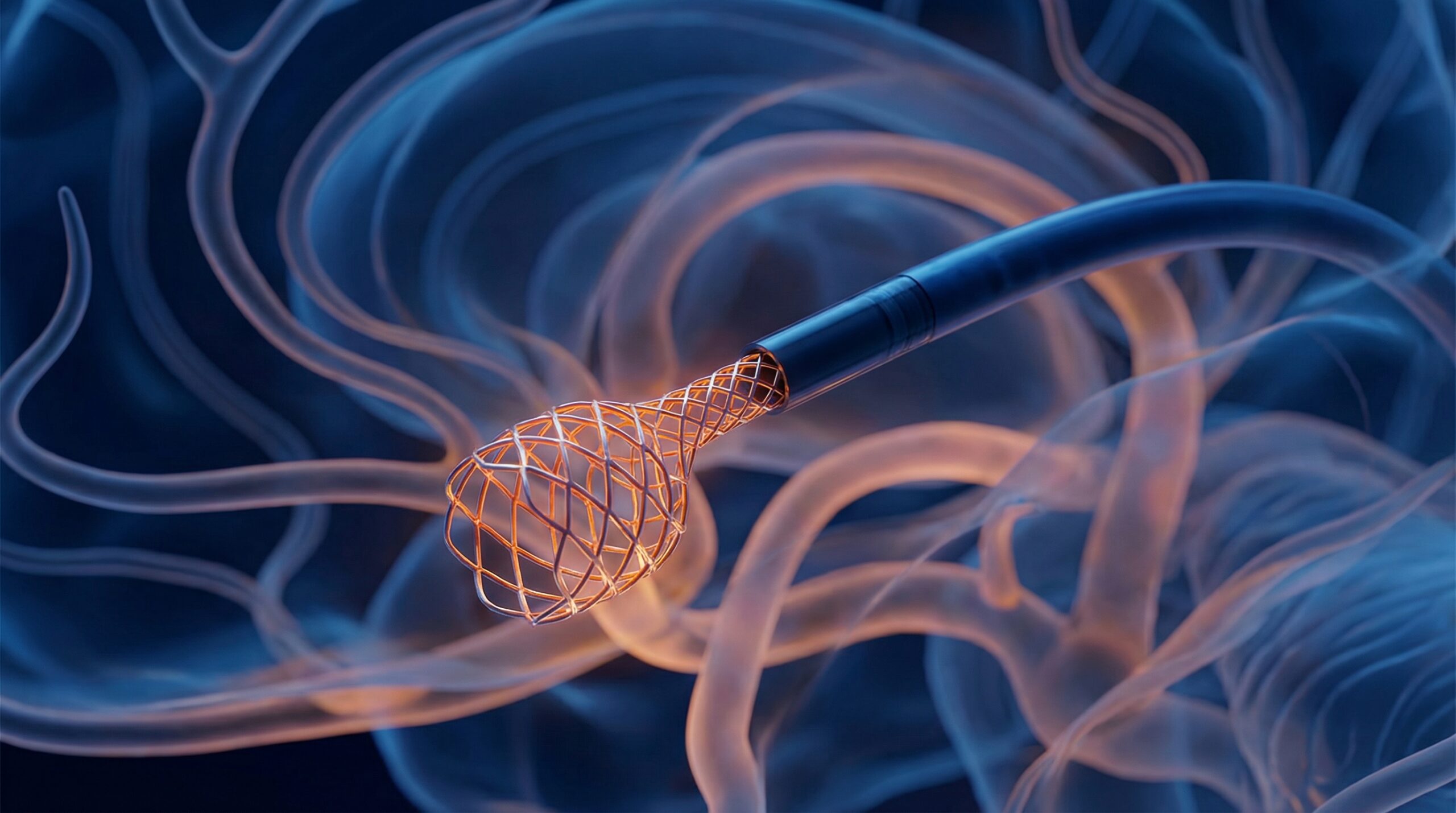
Designing Stents, Flow Diverters, and Thrombectomy Systems as Integrated Platforms
The neurovascular device market is at an inflection point. As interventional techniques advance and patient populations age, the demand for devices that can navigate the brain’s complex vasculature while delivering reliable clinical outcomes has never been higher. Yet the industry continues to struggle with a fundamental design flaw: developing delivery systems and implants as separate components, then forcing them to work together.
The result? Late-stage failures, compromised performance, and devices that work in theory but fail in the most challenging anatomical scenarios.
The solution lies in a paradigm shift: designing neurovascular devices from the implant out, not the delivery system in.
Why Neurovascular Is the Hardest Interventional Category
First-generation neurovascular devices borrowed heavily from coronary and peripheral vascular designs. The industry quickly learned what interventionalists already knew: not all vessels are alike, and device design shouldn’t be either.
The cerebral vasculature presents unique challenges that make neurovascular intervention the most demanding category in interventional medicine:
Extreme anatomical constraints. Brain vessels are narrower, more tortuous, and far more delicate than peripheral or coronary anatomy. Devices must navigate through vessels as small as 2mm in diameter, making sharp turns through complex three-dimensional anatomy while maintaining precise control.
Zero tolerance for trauma. Unlike peripheral vessels that can tolerate minor wall trauma, cerebral vessels are exquisitely sensitive. Any endothelial damage, excessive radial force, or deployment error can trigger catastrophic complications including stroke, dissection, or perforation.
Challenging access pathways. Reaching distal cerebral targets requires devices to travel through multiple vessel segments, each with different diameters, angles, and mechanical properties. The delivery system must balance competing demands: stiff enough to provide pushability through proximal segments, yet flexible enough to navigate distal tortuosity without kinking or losing control.
High deployment forces in constrained spaces. When a device, such as a stent or flow diverter, finally reaches its target, it must deploy with precision in a vessel that may be tapered, curved, or positioned at an awkward angle. The deployment mechanism must provide controlled, predictable release while managing forces that could easily dislodge the device or damage the vessel wall.
These challenges explain why neurovascular devices have the highest failure rates during development and the longest time-to-market among interventional device categories.
Implant Performance Defines Clinical Success
In neurovascular intervention, the implant is not just a component – it’s the entire reason the procedure exists. Whether it’s a stent restoring vessel patency after stroke, a flow diverter excluding an aneurysm, or a thrombectomy device capturing clot, the implant must perform flawlessly at the moment of truth.
Consider what happens when implant design is compromised to accommodate delivery constraints:
Radial force vs. vessel trauma trade-offs. A stent needs sufficient radial force to remain patent and resist vessel recoil. But if the strut design is optimized for ease of delivery rather than optimal radial mechanics, the resulting device may either under-expand (risking thrombosis) or over-expand (causing vessel trauma). The implant’s mechanical properties – determined by strut thickness, pattern geometry, and material selection – must be engineered first, then the delivery system designed to preserve those properties.
Fatigue and durability limitations. Neurovascular implants experience millions of cardiac cycles in a high-stress environment. A stent designed primarily for deliverability may use thinner struts or simplified patterns that compromise long-term durability. The result: late-stage failures, fractures, or loss of structural integrity that only become apparent years after implantation.
Profile vs. performance compromises. The push toward increasingly low-profile delivery systems has created tradeoffs that deserve closer examination. Flow diverters with pore density optimized for aneurysm exclusion can be difficult to compress into microcatheters. Prioritizing deliverability over implant performance, however, risks achieving access without achieving the intended clinical outcome.
Deployment precision failures. When delivery systems are designed independently from implants, deployment mechanisms often fail to account for the implant’s actual behavior during release and the anatomy impact. A stent may foreshorten unpredictably, a flow diverter may dislodge during final deployment, or a filter may lose wall apposition. These aren’t delivery system failures – they’re systems integration failures that stem from treating the implant or working component independently from the full system.
The Cost of Siloed Development
The traditional medical device development model often treats implant design and delivery system engineering as separate workstreams that converge late in the process. This approach consistently produces the same failure pattern:
Late-stage design changes. Implant engineers optimize for clinical performance. Delivery system engineers optimize for navigability and ease of use. When the components finally come together, incompatibilities emerge: the implant can’t be loaded reliably, deployment forces exceed safe limits, or the system fails in tortuous anatomy. The result: expensive design iterations, delayed launches, and compromised performance.
Deployment mechanism failures. A delivery catheter designed without deep knowledge of the implant’s mechanical behavior will struggle to control deployment. The catheter may lack the precise push/pull features needed to manage the implant’s expansion characteristics resulting in a failure to deploy. Radiopaque markers may be positioned incorrectly. The implant may compress or shift during deployment due to high forces. Re-sheathing mechanisms may fail when the implant partially deploys.
Manufacturing complexity. When implants and delivery systems are designed separately, manufacturing becomes an exercise in forcing incompatible components to work together. Tolerances stack. Assembly processes can become unreliable. Quality issues may emerge at scale. The result: high scrap rates, inconsistent performance, and devices that work in R&D but fail in production.
Clinical performance gaps. The ultimate cost of siloed development appears in the cath lab. Devices that performed well in benchtop testing struggle in real anatomy. Operators develop workarounds. Procedure times increase. Complication rates rise. And patients receive suboptimal care because the device wasn’t designed as an integrated system.
The Implant-First Systems Approach
The solution requires inverting the traditional development model. Instead of asking “How do we deliver this implant?”, the question becomes: “What delivery system does this implant need to perform optimally?”
This approach starts with a clear-eyed assessment of clinical requirements:
Define optimal implant performance first. What radial force is needed? What fatigue life? What deployment precision? What are the acceptable limits for foreshortening, recoil, and chronic outward force? These parameters must be established based on clinical needs, not delivery constraints.
Engineer the implant to meet those requirements. Strut patterns, material selection, heat treatment, and surface finishing are all optimized for implant performance. This is where expertise in nitinol mechanics, laser cutting, electropolishing, and fatigue testing becomes critical. The implant must be designed to succeed in the most challenging anatomical scenarios.
Design delivery systems around implant behavior. Only after the implant design is locked do delivery system engineers begin their work. But now they’re working with complete knowledge of the implant’s mechanical properties, deployment characteristics, and performance requirements. The delivery wire, microcatheter interface, deployment mechanism, and radiopaque markers are all engineered specifically for this implant.
Integrate manufacturing from day one. Implant and delivery system manufacturing processes are developed in parallel, with constant communication about tolerances, assembly sequences, and quality control. The result: devices that can be manufactured reliably at scale, with consistent performance and minimal scrap.
Validate as a complete system. Testing doesn’t happen in silos. The integrated device undergoes deployment testing in anatomically accurate models, fatigue testing under physiological conditions, and validation in the most challenging anatomical scenarios. Problems are identified and resolved before clinical trials, not after commercialization.
Why This Matters More Than Ever
The neurovascular device market is evolving rapidly. Indications are expanding. Patients are getting older and more complex. Anatomies are more challenging. Operators expect devices that work reliably in scenarios that would have been impossible five years ago.
In this environment, the companies that succeed will be those that understand neurovascular devices as integrated systems, not assemblies of separate components. They will invest in deep expertise across the entire device. They will resist the temptation to compromise implant performance for ease of delivery. And they will recognize that in the most demanding interventional category, there is no substitute for engineering excellence.
The brain’s vasculature doesn’t forgive design shortcuts. Neither should device developers.